Can GetHookd Improve Your Ad Research Workflow? Exploring Its Database, Brand Spy, and Creative Tools
Ad research can become fragmented surprisingly quickly. One browser tab contains competitor ads, another holds landing pages, screenshots are scattered across folders, and the useful creative someone found last month has already disappeared from the platform where it originally ran. GetHookd attempts to make that process more manageable by combining ad discovery, competitor intelligence, saved research, transcription, scripting, and AI-assisted creative tools within one platform.
For marketers evaluating GetHookd as an ad research and creative intelligence platform, its main strength is not simply the number of advertisements in its database. The more interesting proposition is the workflow surrounding them. Users can discover an ad, study the advertiser behind it, preserve useful examples, extract messaging, and develop new creative directions without continually moving between unrelated tools. That makes GetHookd worth examining as a complete research environment rather than only as another ad library.
Explore Ads Gives Research a Much Larger Starting Point
Searching More Than 23 Million Ads Across Major Platforms
GetHookd's Explore Ads database provides access to more than 23 million high-performing advertisements across Facebook, TikTok, and Google. Bringing those channels together can make research more efficient for marketers who regularly study how hooks, visual formats, product demonstrations, offers, and messaging styles move between platforms. Instead of conducting separate searches across several advertising libraries, users have a central environment for identifying relevant creative patterns.
The scale is particularly valuable when research begins with a specific question. A marketer might investigate how competitors demonstrate a particular product benefit, which opening hooks appear repeatedly within a niche, or how similar offers are presented across different platforms. The database supplies considerable material to work with, while the strategic interpretation remains with the marketer. That is an important distinction because useful competitive research is less about collecting large numbers of ads and more about recognising which patterns are actually relevant.
Brand Spy Adds Context Behind Individual Creatives
Looking at Competitor Activity as a Bigger Picture
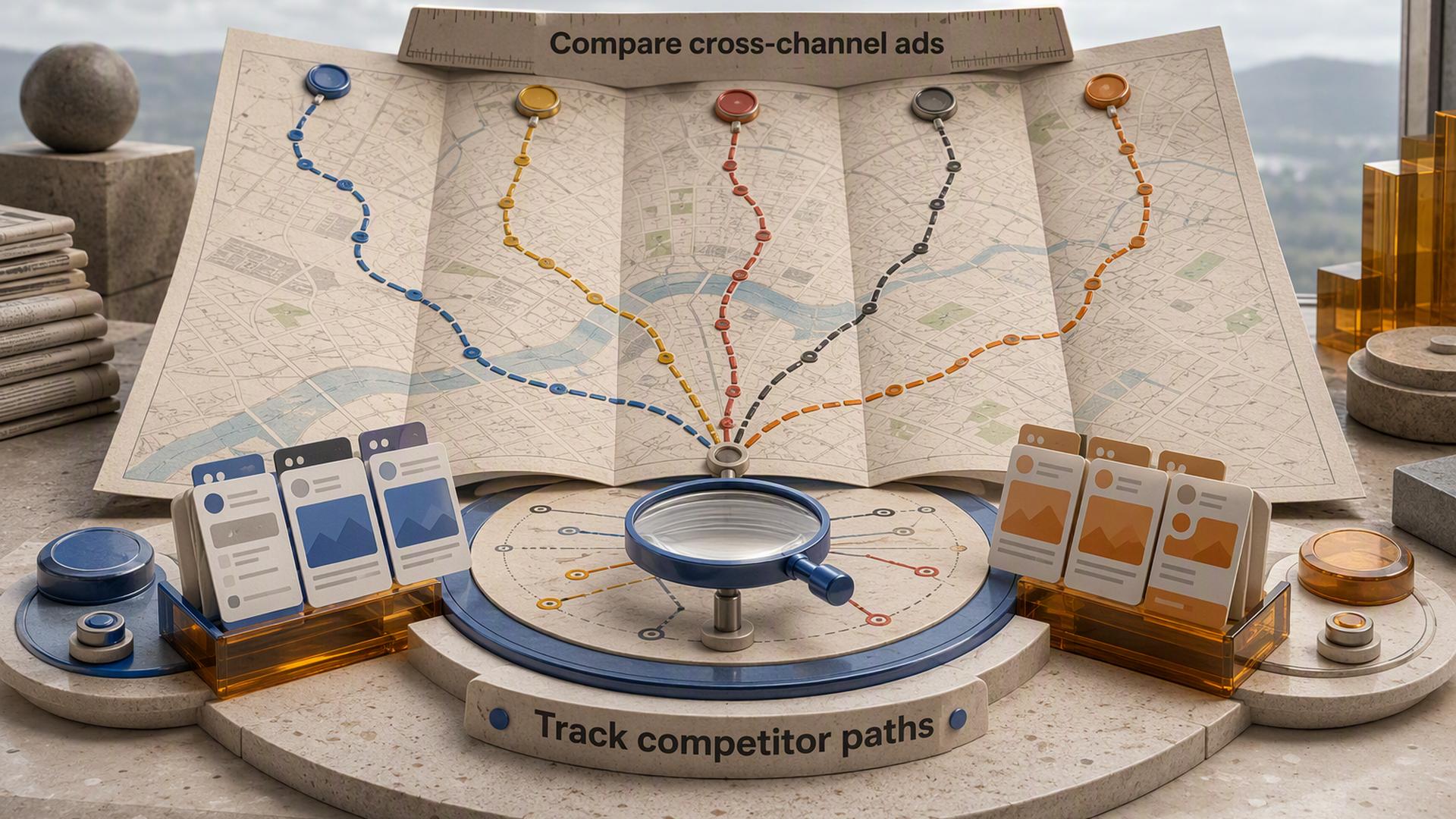
Individual advertisements can be useful references, but they rarely explain an advertiser's broader approach. GetHookd's Brand Spy feature expands the research process by providing visibility into competitors' top ads, landing pages, traffic sources, and related advertising activity. This gives marketers an opportunity to study a company rather than drawing conclusions from one isolated creative.
That wider context can reveal patterns that would otherwise be easy to overlook. If a brand repeatedly returns to the same product benefit, style of testimonial, promotional structure, or landing-page approach, the repetition may be more meaningful than any single advertisement. Comparing several pieces of creative can also help researchers distinguish between an experimental concept and something that appears to form part of a sustained campaign strategy.
Brand Spy is therefore most useful as an intelligence layer rather than a shortcut to campaign planning. It provides evidence about what other advertisers are doing, but marketers still have to decide which observations apply to their own customers, positioning, margins, and goals. That keeps the feature useful without turning competitor activity into a formula that has to be followed.
Saved Ads Make Good Research Easier to Reuse
Building a Swipe File That Survives Campaign Changes
Creative research loses much of its value when useful references cannot be found again. GetHookd addresses that problem with Saved Ads, allowing users to retain advertisements and organise them for future reference. The company states that saved ads remain available even after the original advertisements go offline, which makes the feature particularly useful for marketers building longer-term swipe files rather than collecting temporary bookmarks.
Over time, those saved collections can become a practical working library organised around niches, creative formats, offers, hooks, product demonstrations, or other themes. Agencies can maintain references for different clients, while in-house teams can preserve examples relevant to specific products or campaign objectives. It is a relatively simple part of the platform, but one that helps turn occasional competitive browsing into a repeatable research process.
Transcription and AI Scripts Connect Research With Messaging
Moving From Watching an Ad to Studying How It Is Written
Video advertising can be difficult to analyse efficiently when the important material is buried inside spoken dialogue. GetHookd includes ad transcription tools that convert videos into text, making it easier to examine hooks, calls to action, arguments, and messaging structures without repeatedly replaying the creative. For marketers researching script-heavy Facebook or TikTok ads, that can considerably simplify the process of comparing how different brands communicate similar ideas.
The platform then extends that workflow through AI-generated video scripts. Users can upload a reference advertisement, provide information about their own product, and generate potential hooks, angles, and scripts. The important benefit here is continuity. Research does not have to finish with a transcript sitting in a document. Observations from an existing creative can become inputs for developing a new concept.
As with most AI-assisted writing, the strongest use case is likely to be ideation and iteration rather than treating every generated script as finished campaign copy. Brand voice, factual accuracy, positioning, and audience knowledge still matter. GetHookd simply reduces some of the blank-page work between identifying an interesting advertising structure and producing another idea worth developing.
Creative Tools Extend the Workflow Beyond Ad Research
Generating Variations Without Starting Every Concept From Scratch
GetHookd also includes tools aimed more directly at production. Clone Ads allows users to upload their own creative or a reference advertisement and produce multiple image variations with changes to elements such as colours, avatars, formats, and styles. The platform also incorporates AI image advertising and creative analysis within its credit-based toolset.
For performance marketers, the practical value is speed of variation. A creative concept often needs several executions before a team can determine which visual treatment deserves further testing. Generating starting points from an existing idea can reduce repetitive production work and give designers or marketers more directions to evaluate before committing resources to a complete campaign.
The feature is perhaps best understood as a bridge between intelligence and production. GetHookd does not simply show what competitors have published and leave users to rebuild their process elsewhere. Research can move directly into transcription, scripting, analysis, and creative variation. Teams still make the final creative decisions, but fewer steps have to begin from an empty screen.
The Platform Works Best as a Connected Research System
Where GetHookd Fits Into a Performance Marketing Workflow
The strongest case for GetHookd comes from using several of its features together. Explore Ads can uncover an interesting campaign, Brand Spy can provide context about the advertiser, Saved Ads can preserve the reference, transcription can expose the messaging structure, and the creative tools can help turn those observations into new directions. Used this way, the platform reduces the amount of switching between ad libraries, spreadsheets, folders, transcription services, and separate AI tools.
There are still practical considerations when deciding how deeply to build GetHookd into a workflow. Several advanced functions, including Brand Spy, transcriptions, AI scripts, AI image ads, and Creative Analyzer, operate through credits. Current plans provide different credit allowances and seat counts, so the most appropriate tier depends on research volume and team size. That structure can actually make selection fairly straightforward because solo marketers, growing brands, collaborative teams, and agencies are offered progressively larger allowances rather than an identical package for every type of user.
It is also worth remembering that competitive intelligence becomes more useful when there is a clear research objective behind it. Access to millions of advertisements will not automatically identify the right positioning for a product. GetHookd makes examples, patterns, and creative inputs considerably easier to collect and examine, while experienced marketers still supply the judgement required to decide what should influence the next campaign.
A More Practical Way to Turn Ad Research Into Action
GetHookd makes a convincing case for marketers who want ad discovery to connect more naturally with the rest of their creative process. Its database provides substantial research depth, Brand Spy adds useful competitive context, Saved Ads turns temporary discoveries into reusable references, and the transcription, scripting, analysis, and creative tools provide logical next steps once an interesting idea has been found. The platform does not remove the need for strategic judgement, nor should an ad research tool try to do so. Its value lies in giving marketers a more organised path from seeing what is happening in the market to developing informed creative ideas of their own. For teams that regularly move between competitor research and campaign production, that connected workflow is where GetHookd stands out most clearly.


 Powered by CouchDB